Last updated 2026-08-18
TL;DR
Arizona has no state license for T-hangar condos. Asking prices in 2025 ran roughly $45,000 to $350,000 depending on airport, with monthly ground lease often set by the sponsor. A purchase takes 30 to 90 days if the condominium resale package, airport board approval, and title work line up. Confirm all fees and timelines with the specific airport board.
What is a T-hangar condo in Arizona?
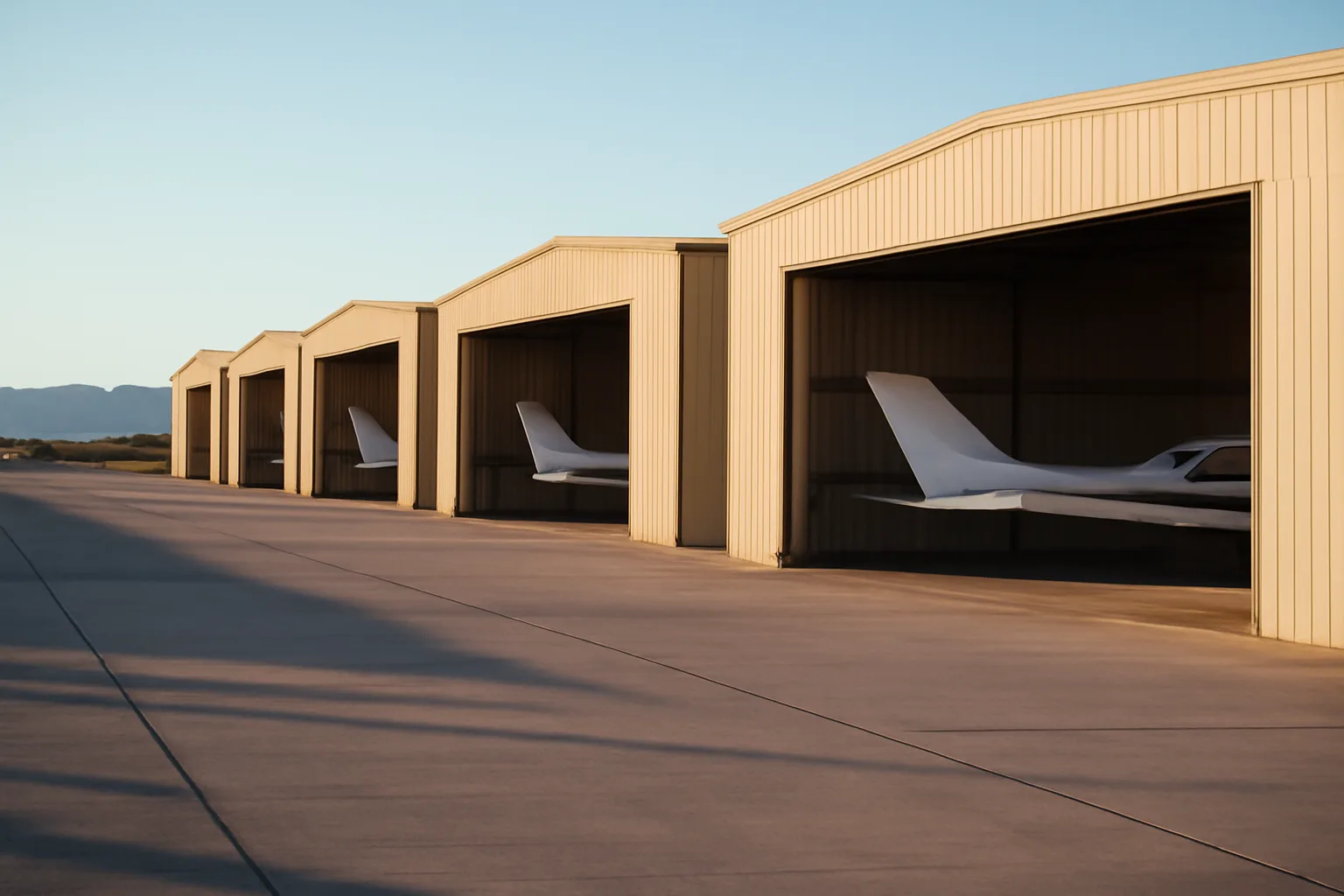
A T-hangar condo is a private unit inside a row of attached metal hangars, usually shaped like a single aircraft slot. You own the interior space, the door, and the walls that separate your unit from the next one. You do not own the dirt under the building. The airport sponsor or a ground lessor holds the land. In Arizona, the condominium form is real property and falls under the Arizona Condominium Act, A.R.S. § 33-1202 [1].
That matters because a hangar condo is more than a leasehold. You get a deed for the unit and an undivided interest in the common areas, plus a long ground lease. The condominium declaration, not a state price list, controls what you can store, how you transfer a unit, and what the association can charge. Read the declaration before you fall in love with a door height.
Do you need a license for a T-hangar condo in Arizona?
No. Arizona has no state license for owning a T-hangar condo, and the FAA does not license hangar owners. The airport sponsor controls use through its lease, minimum standards, and local security plan. You may need an airport badge, proof of insurance, and approval from the airport director or board before you get keys [7].
FAA Advisory Circular 150/5190-7 explains that airport sponsors set minimum standards for aeronautical activities, including hangar operations. The Arizona Condominium Act does not require a buyer to hold a pilot certificate or aircraft registration to buy a unit, though the airport lease often does. Some airports require a tenant to own an aircraft based on the field or show a written aircraft lease. That is a lease condition, not a state license.
Do not pay someone to 'license' your Arizona hangar. There is no such credential. If a service promises a state hangar permit, walk away. The real gating items are the airport's minimum standards, the association's board approval, and the public report on new construction.
How much does a T-hangar condo cost in Arizona?
Public Arizona hangar listings in 2025 ran roughly $45,000 to over $350,000, with the middle of the market around $125,000 [8]. That range is wide because airports set their own prices. No state agency publishes a standard Arizona T-hangar condo price.
A basic single T-hangar at a smaller municipal field can still trade under $60,000. A unit at a demand-heavy field near Scottsdale, Sedona, or Deer Valley can push past $300,000. That price is for the condominium interest, not the ground. You still owe a monthly ground lease to the airport sponsor. Ask for the current lease schedule before you write a check.
What you pay depends on door width, door height, depth, electrical service, insulation, and whether the unit is free-standing or attached. The FAA design standard for the smallest common category, design group I, covers aircraft with a wingspan up to 49 feet and a tail height up to 20 feet [4]. Most older Arizona T-hangars fit that group. If you need a bigger door or taller tail, expect to pay more.
| Cost item | Observed or typical range | Who confirms |
|---|---|---|
| Purchase price | $45,000 to $350,000+ | Seller/broker, public listings |
| Monthly ground lease | Varies by airport | Airport sponsor/board |
| Association fee | Varies by budget | Condo association |
| Closing and title | $1,500 to $4,000 | Escrow officer |
| Inspection | $300 to $800 | Licensed inspector |
What makes Arizona hangar condo prices vary so much?
Airport demand is the biggest driver. Phoenix-area executive airports with long waiting lists have prices that look like residential real estate. Rural airports with empty T-hangars have prices closer to the value of the steel and concrete. The same 1,200 square foot box can differ by five times across the state.
The remaining lease term drives price more than most buyers realize. A condo with nine years left on the ground lease trades differently than one with thirty years left. Arizona law does not set a minimum remaining term for sale, so the market sets it. Before you agree on a price, ask when the ground lease expires and what the sponsor charges to extend it.
Door size and tail height filter buyers. A narrow door cuts the buyer pool. A 42-foot clear opening fits many single-engine pistons, but a 48-foot opening costs more. That FAA design group I data gives you a useful yardstick [4]. The more flexible the unit, the more bidders you will have when you sell.
What are the monthly costs after you buy?
You will pay a ground lease, association dues, insurance, and possibly property taxes on the unit or leasehold interest. The ground lease is set by the airport sponsor and often billed monthly or annually. No Arizona state cap sets that rate, and the FAA requires only that fees be reasonable and non-discriminatory under the sponsor's assurances [5].
Association dues cover common area maintenance, security gates, and sometimes shared hangar lot lighting. Ask for the last two years of association budgets and any special assessment history. A well-run association has a reserve study. A poorly run one has surprise assessments.
Insurance is your problem. The condominium master policy may cover the building shell, but you'll need your own contents and liability coverage. Some airports require a $1 million liability policy with the airport sponsor named as an additional insured. Check the lease, not a national quote.
How long does a T-hangar condo purchase take in Arizona?
Budget 30 to 90 days, and no state deadline locks that window. A cash purchase with a current resale package and no financing can close faster, but three things usually add time: association resale document delivery, airport board approval, and title work on the leasehold.
Arizona law requires a condominium association to provide certain resale disclosures and documents before a sale can close, under A.R.S. § 33-1256 [9]. If the association is slow or the resale certificate is missing, you wait. Airport boards often meet monthly, so a purchase can sit for two or three weeks waiting for the next meeting.
Do not promise a seller a ten-day close unless you have all three documents in hand. I'd plan for six weeks and be happy if it happens in five. The actual board-confirmable timeline is whatever the board says. No national guide can override that.
What paperwork shows up in an Arizona hangar condo closing?
Expect a unit deed, a condominium declaration, a ground lease or ground lease assignment, resale disclosure documents, and if the project is new, a public report from the Arizona Department of Real Estate. For any new condo, state law requires the developer to obtain an ADRE public report before offering units [2]. Buyers can search ADRE's public report database [3].
Resale units do not need a new public report, but they still need the association's resale package under A.R.S. § 33-1256 [9]. That package includes the governing documents, budget, reserve study, insurance summary, and any unpaid assessments.
This is where the THangarPath $199 one-time FAA Lease + Condo-Doc Kit saves you from paying a lawyer to tell you what to ask for. It's a document checklist and template set, not legal advice. You can get it at /start.
What does the FAA actually care about?
Federal money changes the rules. If the airport took FAA grants, it signed Airport Sponsor Assurances. Grant Assurance 23 says the sponsor "will not grant or permit any exclusive right for the use of the airport" [5]. A T-hangar condo project cannot lock out other aeronautical users in a way that violates that assurance.
The FAA also expects hangars to be used for aircraft storage, not as unpermitted apartments, shops, or self-storage. FAA Order 5190.6B, the Airport Compliance Manual, explains that sponsors must enforce aeronautical use provisions in hangar leases and condo declarations [6].
For a buyer, this means the airport board has a federal reason to care about your intended use. Bring your aircraft, a written lease if you don't own one yet, and proof of insurance. Do not describe your hangar as a man cave in front of the board.
How do you check an Arizona airport's ground lease before you buy?
Ask the airport sponsor or board for the current ground lease form, the rent schedule, and any written policy on lease extensions. Compare the remaining term to the purchase price. A low price with five years left can cost more than a high price with thirty years left.
Review the condominium declaration's use restrictions. Some associations ban paint booths, fuel storage, or non-aeronautical equipment. If you plan to keep a vehicle, an RV, or a business inventory in the hangar, confirm the declaration allows it. Airport minimum standards may prohibit non-aeronautical items [7].
The Arizona Department of Transportation's Aeronautics Group maintains an airport directory that lists public-use airports and their contacts [10]. Call the airport manager, not the seller, and ask for the current board meeting date. If you are buying a unit at a private airpark, the declaration and private covenants do the same work.
Arizona vs. other states: what is different?
Arizona has no state hangar license or fixed fee schedule, which is the same pattern you'll see in Florida, California, Colorado, and Alabama. The differences are market-driven and lease-driven, not statutory. Florida has more coastal inventory and hurricane insurance costs. California tends to have higher purchase prices and tougher environmental reviews. Colorado adds snow load and altitude concerns. Alabama can be cheaper on price but similar on ground lease risks.
Do not assume an Arizona hangar condo is cheaper than a California one. Some Scottsdale-area units price like small California hangars. Compare the total first-year cost, more than the sticker. That includes purchase price, monthly lease, association dues, insurance, and any unpaid special assessment.
What is a waste of money on an Arizona hangar condo?
Paying a consultant to find you a hidden hangar is often waste. Public listings and airport manager calls do the same work. Paying for a new ADRE public report on a resale unit is also waste. You need the association's resale package, not a developer's public report [9].
A pre-purchase hangar inspection is not waste. Spend the $300 to $800 on a licensed inspector who knows metal buildings and door hardware. You want the door opener, the hangar door springs, the roof fasteners, and the electrical panel checked. Foundation cracks in a forty-year-old Arizona hangar can cost more than the down payment.
Arizona T-hangar condo first-year checklist
1. Get the current condominium declaration, ground lease, association budget, and last twelve months of board minutes. 2. Confirm remaining lease term and extension option with the airport sponsor. 3. Check the ADRE public report if the project is new construction [2][3]. 4. Read the airport's minimum standards for aeronautical use and storage limits [7]. 5. Inspect the unit before you sign, focusing on door, roof, electrical, and concrete. 6. Confirm the association's resale packet under A.R.S. § 33-1256 [9]. 7. Buy your own insurance with the airport sponsor named if the lease requires it. 8. Get board approval in writing, with any conditions. 9. Record the deed and ground lease assignment. 10. Set aside the first year's ground lease, association dues, and a small maintenance reserve.
Frequently asked questions
Do you need a license for a T-hangar condo in Arizona?
No. Arizona does not issue a T-hangar condo license, and the FAA does not license hangar owners. The airport sponsor controls use through its lease, minimum standards, and security plan. You may need airport badge approval, proof of insurance, and board sign-off before you get keys. The only 'license-like' document is the condominium declaration and ground lease, not a state permit.
How much does a T-hangar condo cost in Arizona?
Public Arizona listings in 2025 ran roughly $45,000 to over $350,000, with a loose middle around $125,000. Small municipal units can trade under $60,000. High-demand fields near Scottsdale, Sedona, or Deer Valley can push past $300,000. No state agency publishes a fixed price. Confirm the current asking and lease terms with the specific airport board.
How long does a T-hangar condo purchase take in Arizona?
Budget 30 to 90 days. A cash purchase with a current resale package can close faster, but airport board approval, resale document delivery under A.R.S. § 33-1256, and leasehold title work usually add weeks. Boards often meet monthly, so a closing can wait two or three weeks for the next meeting. Confirm the board's timeline before you write a check.
Do I need to own an aircraft to buy an Arizona hangar condo?
State law does not require aircraft ownership, but the airport lease often does. Some sponsors require the buyer to own an aircraft based at that field or to show a written aircraft lease. Check the condominium declaration and ground lease before signing. If the airport minimum standards require aeronautical use, you'll need an aircraft or a compliant tenant.
Can I live in my Arizona T-hangar condo?
Generally no. The FAA expects hangars to be used for aircraft storage, not as living quarters, under FAA Order 5190.6B. Airport minimum standards and local zoning also prohibit residential use in a T-hangar. A hangar condo is not a tiny home or apartment. Treat the space as aircraft storage and light aviation equipment only.
What is a typical monthly ground lease at an Arizona airport?
No Arizona state cap sets the ground lease, and public rates vary widely. Some rural airports charge a few hundred dollars per month, while high-demand Phoenix-area fields can charge much more. Ask the airport sponsor for the current lease schedule and extension policy. Do not rely on a previous owner's payment amount because lease rates can reset on transfer.
Can I rent out my Arizona T-hangar condo when I'm not flying?
Yes, if the condominium declaration, airport lease, and minimum standards allow it. Many associations permit renting the unit to another aircraft owner or renter, but the airport sponsor may require a background check and proof of aeronautical use. Non-aeronautical storage or office use is often prohibited. Get written permission before you advertise.
Does Arizona require a public report for hangar condo resales?
No. A public report from the Arizona Department of Real Estate is required for new condominium projects under A.R.S. § 33-1260. Resale units do not need a new public report, but the association must provide a resale disclosure packet under A.R.S. § 33-1256. Confirm the packet is current before closing.
What insurance does an Arizona airport require for a hangar condo?
Many airport leases require the condo owner to carry general liability coverage, often $1 million, with the airport sponsor named as an additional insured. The condominium master policy may cover the shell, but you need your own contents and liability coverage. Check the specific lease and association insurance summary. Ask for the current certificate wording from the board.
Can a non-pilot buy an Arizona hangar condo?
Yes in principle. Arizona law does not require a pilot certificate to own a hangar condo. But the airport sponsor often requires aeronautical use and may want proof of an aircraft, a written aircraft lease, or an aviation-related business. A non-pilot investor can buy if the declaration and airport minimum standards allow renting to a qualified tenant.
How do I check if an Arizona hangar condo has a clear title?
Use a title company or escrow officer that knows leasehold condominiums. Order a title commitment, check the condominium declaration for liens, and confirm the ground lease is assignable. Ask the association for any unpaid assessments on the unit. The title work should cover both the unit deed and the leasehold interest.
Is a hangar condo in Arizona real property or personal property?
A hangar condominium is real property under the Arizona Condominium Act, A.R.S. § 33-1202. You get a deed for the unit and an interest in the common areas. The ground underneath remains real property held by the airport sponsor or ground lessor. That separation is why the ground lease term matters so much to resale value.
Sources
- Arizona Revised Statutes § 33-1202: Arizona Condominium Act applies to condominiums created in Arizona, including hangar condos.
- Arizona Revised Statutes § 33-1260: A developer must obtain a public report from the Arizona Department of Real Estate before offering condominium units for sale.
- Arizona Department of Real Estate, Condominium Public Reports: Public reports are available from ADRE; buyers can search for a condominium project.
- FAA Advisory Circular 150/5300-13B, Airport Design: FAA design group I aircraft have a wingspan up to 49 feet and tail height up to 20 feet, typical for standard T-hangars.
- FAA Airport Sponsor Assurances, Grant Assurance 23: Airport sponsors may not grant exclusive rights for aeronautical use of the airport.
- FAA Order 5190.6B, Airport Compliance Manual: FAA reviews hangar leases and use agreements for aeronautical use and reasonable terms.
- FAA Advisory Circular 150/5190-7, Minimum Standards for Commercial Aeronautical Activities: Airport sponsors set minimum standards for hangar use; no FAA hangar owner license exists.
- Hangar Trader, Arizona hangars for sale: Public Arizona hangar listings in 2025 show asking prices from roughly $45,000 to over $350,000.
- Arizona Revised Statutes § 33-1256: Arizona law requires condominium associations to provide certain resale disclosures to a unit buyer.
- Arizona Department of Transportation, Aeronautics Group, Airport Directory: ADOT lists public-use Arizona airports and contact information for verifying local hangar rates and board meetings.