Last updated 2026-08-21
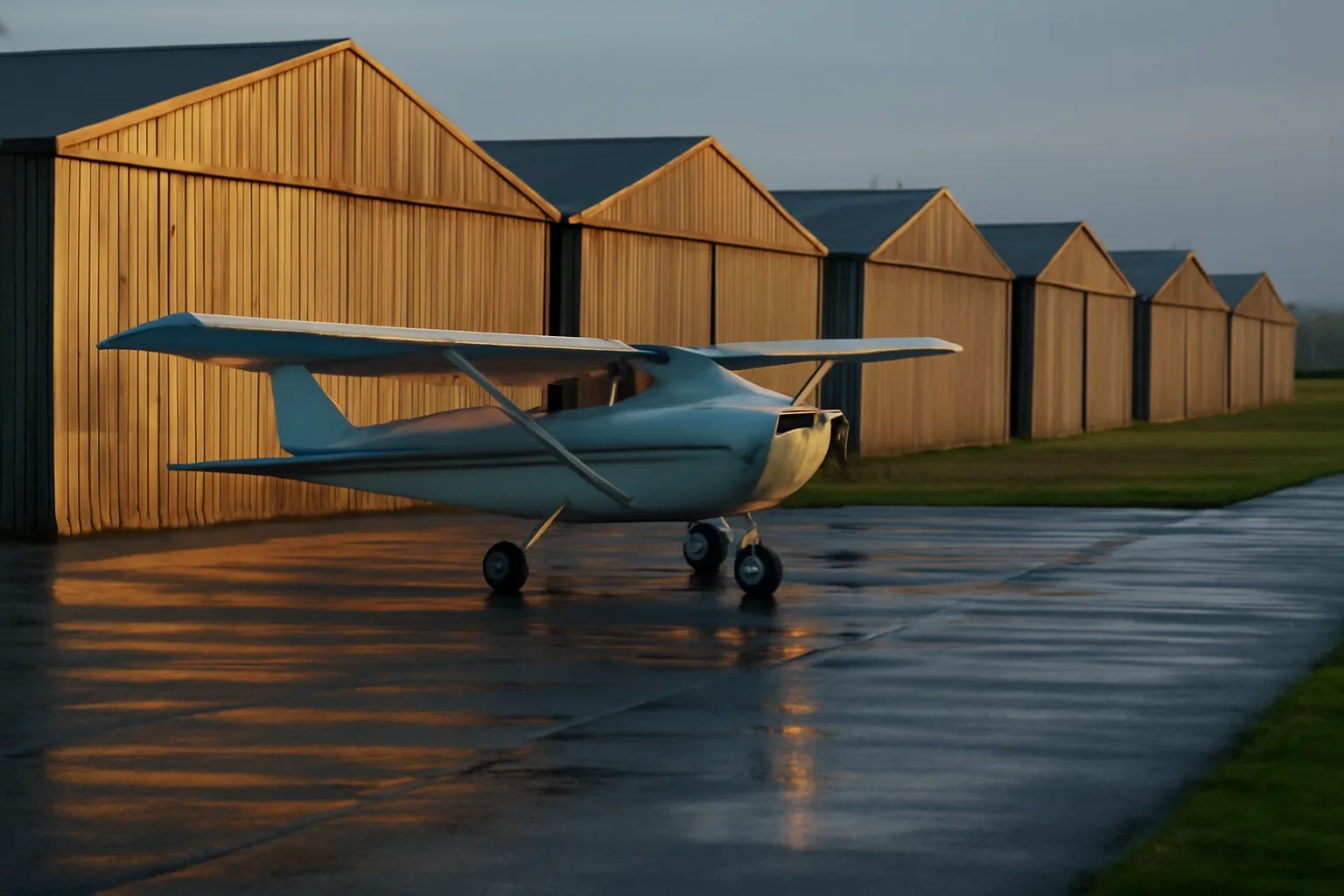
TL;DR
Delaware does not issue a T-hangar condo license. You form an entity ($90 LLC filing, $300 annual tax), negotiate a ground lease the airport board will actually vote, record a DUCIOA declaration and plats, and pull county building plus stormwater approvals (5,000 square feet is the usual trigger). Construction and lease talks dominate cost and time. Confirm fees and calendars with Corporations, Revenue, the county, and the airport. No one can guarantee a vote.
What is a T-hangar condo in Delaware?
A T-hangar condo in Delaware is a row of nested aircraft stalls sold as real estate units, usually sitting on leased airport land, with shared taxilanes treated as common elements. It is not a state license class. It is a land deal plus a condominium declaration recorded under the Delaware Uniform Common Interest Ownership Act (DUCIOA), Title 25, Chapter 81 of the Delaware Code [1].
You buy (or you sell) a unit. The association runs the roof, doors, and pavement the declaration says it runs. The airport still owns the dirt on a typical ground lease. That split surprises people. Read the lease before you fall in love with the rendering.
Delaware does not have a dense GA airport grid. New Castle Airport (ILG), Sussex County Airport (GED), and Delaware Airpark (33N) are the names that come up first. A few privately owned public-use fields exist too. If you are comparing bigger state inventories, the paper path in Texas or California looks busier only because there are more sponsors to ask.
I treat a T-hangar condo as three stacks of paper that have to agree with each other. The airport lease. The recorded declaration and plats. The county building and stormwater files. When those stacks fight, you lose years.
How much does a T-hangar condo cost in Delaware?
There is no official Delaware T-hangar condo fee. Construction dominates the checkbook. State paper does not.
Delaware LLC formation costs $90 at the Division of Corporations [2]. The LLC annual tax is $300 [3]. Most firms also pull a Division of Revenue business license. 30 Del. C. § 2301 sets a $75 license fee for a long list of occupations unless a different fee is specified [4]. Realty transfer tax hits later when you deed units. Confirm the current state and county rates with the recorder. Do not price a stall off a blog.
| Paper item | Figure | Where to confirm |
|---|---|---|
| LLC Certificate of Formation | $90 | Division of Corporations |
| LLC annual tax | $300 | Division of Corporations |
| Typical business license | $75 | Division of Revenue, 30 Del. C. § 2301 |
| Sediment and stormwater plan | Usually required at 5,000 sq ft | 7 DE Admin. Code 5101 |
| Legal work and steel | Engagement letter and bids | Delaware counsel, airport bid tabs |
Legal work is the next real invoice. A DUCIOA declaration, bylaws, plats, and a public offering statement are lawyer products. Nobody publishes a state fee schedule for that. I would budget a five-figure legal bill on even a small building and get the estimate in writing before I sketch steel. Cheap templates that ignore the ground lease are a waste of money.
Construction and site work are local bids. Steel, hangar doors, taxilane pavement, electrical, and drainage move with the market. Nobody publishes a clean Delaware T-hangar unit-cost series. The closest honest number is the last hangar bid tab the airport manager will share. Then add a contingency. People who skip geotech and stormwater on a greenfield pad regret it.
First-year cash is easy to undercount. Association insurance, door maintenance, snow around New Castle County, a reserve contribution, and a bookkeeper. DUCIOA lets the association assess common expenses [1]. If you are the declarant holding unsold units, those assessments can sit on you.
Do you need a license for a T-hangar condo in Delaware?
No. Delaware does not issue a T-hangar condo license. There is no hangar-condo board, quota, or special stamp.
You still collect ordinary licenses and approvals. Form the entity with the Division of Corporations [2]. If you are doing business in the state, get the business license the Division of Revenue assesses under Title 30 [4]. If you are the builder, Title 30, Chapter 25 contractor licensing applies. Confirm the class with Revenue before you pull a building permit [5]. Selling units to the public triggers DUCIOA purchaser-protection rules, including a public offering statement. That is not a hangar license [6].
The airport's blessing is the approval that actually gates the project. That is a lease or development agreement, often voted by a county board, an airport commission, or DelDOT on a state-owned field. It is a contract. Boards change their minds. Get it in a recorded lease.
Real estate brokerage is separate. Owner-declarants sometimes sell their own units. If you hire agents, they need Delaware real estate licenses under 24 Del. C. Chapter 29. I am not going to pretend that line is always clean. Ask the Real Estate Commission if your marketing plan is loud.
People coming from Alabama or Tennessee ask the same license question. The honest answer is usually the same. Ordinary business, contractor, and real estate paper. No magic hangar card.
How long does a T-hangar condo take in Delaware?
Nobody should quote you a guaranteed Delaware timeline. I will not.
Entity formation at the Division of Corporations is the fast piece. Regular filing is often measured in days. Expedited service exists if you pay for it. Confirm current turnaround and expedite fees with the Division before you promise a closing date [2][3]. I do not publish those clocks here because they move.
The lease is the long pole. A clean request at a small field can still take several monthly board cycles. A messy one at ILG, with grant-assurance review and a waiting-list fight, can sit for a year or more. There is no statutory shot clock. If someone sells you a 90-day package, they are selling hope.
County building permits and sediment and stormwater approval run on the county's clock. Disturb 5,000 square feet or more and you are in Delaware's sediment and stormwater program unless an exemption fits [7]. Plan review is not instant. FAA Form 7460-1 airspace review under 14 CFR Part 77 sits on its own calendar if your structure needs notice [8].
Construction depends on the building. A single nested T-hangar row is a different job than a 20-unit complex with new taxilane. I would not bid my own calendar until steel lead times are in writing.
Record the declaration when the plats match what you are allowed to build. Selling hard off a napkin before the lease is signed is how you buy litigation.
Which Delaware airports can actually host a T-hangar condo?
Start with who owns the land and whether the airport is federally obligated. ILG (New Castle County), GED (Sussex County), and Delaware Airpark (33N, in the DelDOT world) are the realistic public-use conversations.
Smaller public-use and private fields exist. A private strip can host a building. You lose the public-airport machinery and you may gain neighbor and zoning pain. I would not assume a backyard strip can be sliced into deeded condos without a zoning fight.
Federally obligated airports live under grant assurances and FAA hangar-use policy. The FAA's 2016 hangar policy is blunt about purpose. "The following are considered aeronautical uses of hangar space: storage of active aircraft; final assembly of aircraft under construction; non-commercial construction of amateur-built or kit-built aircraft; maintenance, repair, or refurbishment of aircraft, but not the indefinite storage of non-operational aircraft; and storage of aircraft handling equipment (e.g., tow bars, glider tow equipment, workbenches) and tools used for aircraft maintenance." That list is from the FAA Policy on the Non-Aeronautical Use of Airport Hangars [9].
If the field took AIP money, exclusive-rights and rates-and-charges rules apply. FAA Order 5190.6B is the compliance manual airport lawyers actually pull [10]. You do not file a condo application with the FAA. The sponsor does the compliance work. You give them a lease they can defend.
Through-the-fence access onto a federally obligated airport is usually a bad bet. I would not build a business plan on it.
Zoning overlays around ILG and military airspace near Dover are real constraints. Confirm airport overlay, height, and lighting with the county before you buy a sketch.
What do the FAA and the airport sponsor require on the lease?
The FAA does not license your condo. The sponsor's federal obligations still shape every clause that matters.
Grant Assurance 22 (economic nondiscrimination), Assurance 23 (exclusive rights), and Assurance 24 (fee and rental structure) are the ones that show up in hangar fights [10]. A condo that locks the airport into one operator forever, or that prices aeronautical users off the field, gives the sponsor a compliance headache. They will slow you down. They should.
Lease term matters more than people admit. Hangars last a long time. Ground leases that expire before the steel is paid are ugly. Residual value and reversion of improvements need plain English. Who owns the building at year 25? Who must demolish? I want those answers in the lease, not in a side email.
Sublease and assignment rules decide whether unit deeds even work. If the airport must consent to every unit transfer, your condo is a stack of subleases with extra steps. Some sponsors will not allow true condominium conveyances on leased land. Ask that on day one. If they only allow licenses to occupy, walk or restructure.
FAA Advisory Circular 150/5300-13B sets airport design geometry, including taxilane object free areas around T-hangars [11]. Your architect should design to that AC, not to a catalog drawing from a steel vendor who has never stood on a Delaware ramp.
Insurance, environmental indemnity, and redevelopment rights belong in the lease. So does a clear map. I have seen people survey the wrong row.
How do you create the condo on paper under DUCIOA?
You create a Delaware common interest community by recording a declaration that meets DUCIOA. Title 25, Chapter 81 is the statute [1]. Subchapter II covers creation, alteration, and termination [12].
25 Del. C. § 81-201 says "this chapter applies to all common interest communities created within this State after the effective date of this chapter" [12]. If you are creating this now, you are in the chapter. Do not invent a one-off hangar club and hope the recorder saves you.
The declaration names the units, the common elements, the allocated interests, and the restrictions. Hangar use restrictions should match the airport lease and the FAA aeronautical-use list [9]. If the declaration lets someone store a boat for years and the lease says aircraft only, you built a lawsuit.
Plats and plans have to be recordable. Hire a Delaware surveyor who has recorded condo plats before. County recorder quirks are real.
If you offer units to purchasers, Subchapter IV purchaser protections apply. That includes a public offering statement [6]. The Common Interest Community Ombudsperson in the Department of Justice publishes guidance and takes complaints after communities exist [13]. They are not your closing department.
Bylaws, a budget, and an association entity (often a Delaware nonstock corporation or an LLC) come with this. Pick counsel who has done DUCIOA, not only residential towers in Wilmington. Hangar common elements are doors, residual pavement, and snow. They are not lobby fountains.
If you want a checklist of FAA lease clauses and condo-doc headings in one packet before you hire that counsel, THangarPath sells a $199 one-time FAA Lease + Condo-Doc Kit at /start. It is a document kit, not legal advice, and it does not file anything for you.
What county permits, stormwater rules, and tax parcels hit you?
Delaware building permits are county (or municipal) work. New Castle, Kent, and Sussex do not share a back office. You pull the permit where the dirt sits.
New Castle County Land Use runs building permits around ILG [14]. Kent County Planning Services covers the Cheswold area. Sussex Planning and Zoning covers GED. Confirm the current application, impact fees, and plan calendar with the county that has the parcel. I will not invent a permit fee. Those schedules change.
Delaware's sediment and stormwater program generally requires a plan once land disturbance hits 5,000 square feet [7]. Hangar pads plus taxilanes blow past that number fast. Budget a civil engineer who has stamped 7 DE Admin. Code 5101 plans. People who treat this as a building-permit footnote redo grading.
Wetlands, tax ditches, and source-water overlays show up in Sussex more than visitors expect. A cheap site next to the airport fence is not cheap if DNREC has a wetland flag.
After the building exists, assessment offices create tax parcels for units. DUCIOA treats units as separate parcels once there is a unit owner other than the declarant [1]. Coordinate the plat with the county assessment office or you will spend a winter arguing about who pays the bill.
Fire, electric, and door-safety inspections are ordinary. T-hangar door operations hurt people. Spec the safety edges and the maintenance rule in the association documents.
What do first-year T-hangar condo operations actually look like?
Year one is collections, insurance, and door repairs. It is not a club brand.
Pass a budget. Levy assessments the way the declaration allows [1]. Buy association property insurance and general liability. Hangarkeepers coverage is a different product than a residential HOA package. Talk to an aviation underwriter, not only a house-condo agent. I would not cheap out here.
Rules should track aeronautical use. Fuel in unauthorized cans, space heaters, spray painting, and running an unapproved repair shop are how you pick a fight with the airport fire marshal and the FAA hangar policy at the same time [9]. Write the rule. Enforce it once.
Reserves for doors and pavement. T-hangar doors fail. Pavement fails. If you skip reserves to keep dues pretty, you will special-assess the same owners who bought because dues were pretty.
Taxes. Each unit should get a bill. Common elements should not surprise you with a separate theory. Confirm with the assessment office after the plat records.
Meetings, minutes, and a bank account in the association's name. Delaware associations can end up in front of the Ombudsperson if they run dirty [13]. Keep the books boring.
If you still hold most units, you are the association. Budget for that. Declarant control periods end. Read that clause twice.
What would I skip, and what would I actually spend on?
I would spend on a boundary and topo survey, aviation-competent Delaware counsel, and a civil engineer who has cleared 5101 review [7]. I would spend on a ground lease that allows unit deeds. If the sponsor will not allow deeds, I would stop or restructure before I order steel.
I would not spend on a glossy national hangar condo license kit that talks like every state has a board. Delaware does not [4][5]. I would not pre-sell units off social media before the airport votes. I would not copy Arizona CC&Rs and change the state name. Dry heat and Delaware frost heave are not the same climate, and the bigger miss is the lease.
Steel vendors will sell you a building that ignores taxilane object free area. That is a waste if the airport makes you move it. Design to AC 150/5300-13B first [11].
Fancy clubhouses on a six-unit T-row are a waste. Owners wanted a dry stall and a working door. Spend the clubhouse money on door operators and a reserve study.
Comparing other state guides is useful for tone, not for copying forms. Colorado mountain GA condos live in a different sponsor culture. Steal questions from those writeups. Do not steal their declaration.
What should you confirm with the board before you write a check?
Before you write a serious check, put these in an email to the airport manager and ask for written answers. Verbal nods at the hangar door do not count.
Is the airport federally obligated? Will the sponsor allow a recorded condominium on a ground lease, with unit deeds? What lease term, rent formula, and reversion apply? Is there a hangar waiting-list policy that blocks a private condo? Who maintains the taxilane? What minimum standards apply if a unit owner wants to wrench for hire?
Then call the county. What overlay zoning? What is the current building-permit path for an aircraft hangar [14]? Does 5,000 square feet of disturbance put this parcel in 5101 review [7]? Any wetlands flags?
Then call Delaware counsel. Does DUCIOA require a public offering statement for this offering [6]? What entity should be declarant? How do we keep the declaration and the lease from contradicting each other?
No one can promise approval. County boards and airport commissions vote. Votes slip. If a consultant guarantees a date, hire someone else.
The same $199 kit is at /start if you want headings in one place before that counsel meeting. Hire Delaware people for the filings.
Can you sell T-hangar condo units before the building exists?
Sometimes. That is a presale plus a public offering statement problem, not a party on the ramp.
DUCIOA Subchapter IV is built for offerings to purchasers [6]. If you take deposits, you need escrow language and cancellation rights that match the statute. I would not touch purchaser money until counsel has an offering statement in a form they will sign their name under.
The airport may forbid presales or assignment of unbuilt units. Put that in the lease conversation. A declaration that promises closings the lease cannot deliver is junk paper.
Construction lenders want pre-sales. Airports want finished aeronautical capacity. Those two clocks fight. Expect it.
If the project is really a buddy group of four owners building for themselves, you may structure it as a joint venture that later converts to units. That can be cleaner than a fake public offering. It can also trap you if one partner quits. Get the buyout in writing before anyone orders doors.
Frequently asked questions
Do you need a license for T-hangar condo in Delaware?
No special T-hangar condo license exists in Delaware. You still form an entity, pull any Division of Revenue business license that applies, and get a contractor license if you are the builder. Selling units can trigger a DUCIOA public offering statement. The airport lease is the real gate, and it is a board vote, not a license card.
How much does T-hangar condo cost in Delaware?
State paper is small. LLC formation is $90 and the LLC annual tax is $300. A typical business license is $75 under 30 Del. C. § 2301 unless another fee applies. Legal work for a DUCIOA declaration is a five-figure counsel invoice on most projects. Steel, doors, pavement, and stormwater dominate. Ask the airport for recent hangar bid tabs and confirm every fee with the agency that bills it.
How long does T-hangar condo take in Delaware?
Entity filing is the short piece, often days, with paid expedites available. Confirm current clocks with the Division of Corporations. The ground lease and board vote are the long pole and can run many monthly cycles or more than a year at a busy obligated airport. Permits and 5,000-square-foot stormwater review add their own calendars. Nobody can honestly guarantee a date.
Can I put a T-hangar condo on a private Delaware strip?
Maybe as a building project. Deeded condos still need a recordable declaration, zoning that allows the use, and a survey the recorder will take. You lose public-airport process and you may gain neighbor fights. Private strips are not a shortcut around DUCIOA if you are selling units. Have counsel look at title and zoning before you order steel.
Does DUCIOA apply to a small 6-unit T-hangar building?
If you create a common interest community in Delaware after DUCIOA's effective date, Title 25, Chapter 81 generally applies. Small unit count does not magically exempt you. Some narrow statutory exceptions exist. Do not guess. Ask Delaware counsel whether your structure is a condominium, a planned community, or something the statute does not reach.
Who owns the taxilane in front of the T-hangars?
Usually the airport still owns the land. The declaration may call the pavement a common element the association must maintain, or the lease may keep taxilane maintenance with the sponsor. That split has to match. If the papers disagree, winter plowing turns into a fight. Get a labeled exhibit in both the lease and the plat.
Can I store a boat or car in my T-hangar at ILG?
Not as the primary use on a federally obligated airport. FAA hangar policy treats storage of active aircraft and listed aeronautical work as the point of the building. A car as an incidental item while the airplane is there is a different fact pattern than using the stall as a garage. The lease and the association rules can be stricter than the FAA list. Read both.
Do I need a Delaware contractor license to build the hangars?
If you are the person contracting the construction in Delaware, Title 30, Chapter 25 contractor licensing is the chapter to read. Hiring a licensed Delaware contractor is the cleaner path for most declarants. Confirm the class and any bond with the Division of Revenue before the county will treat your permit as complete. Do not invent an exemption.
What happens when the airport ground lease ends?
Read the reversion clause. Many airport leases say improvements become the sponsor's property, or that you must remove them. Unit deeds sitting on expired dirt are a mess. I want term, renewal options, rent resets, and demolition duty in the recorded lease before anyone closes on a unit. If the sponsor will not put that in writing, I would not sell units.
Can a Delaware LLC be the declarant?
Yes. People use a Delaware LLC as declarant all the time. File the Certificate of Formation ($90), pay the $300 annual tax, and keep a business license if Revenue says you need one. The association itself is often a separate nonstock corporation or LLC. Counsel should map who owns unsold units and who controls the board during declarant control.
Do I need FAA Form 7460-1 for T-hangars?
On-airport construction often needs notice under 14 CFR Part 77. File through the FAA OE/AAA process when the structure meets the notice criteria, which hangars near runways usually do. The airport manager has done this before. Build the 7460-1 into the design calendar. A determination is not a land-use approval and it is not a condo license.
Is through-the-fence a workaround for a Delaware T-hangar condo?
I would not treat it as one. Through-the-fence access onto a federally obligated airport is a compliance headache for the sponsor and a fragile right for you. FAA Order 5190.6B is not kind to sloppy off-airport access schemes. If you do not have a recorded on-airport lease the board will defend, you do not have a project I would sell to strangers.
Sources
- Delaware Code, Title 25, Chapter 81 (DUCIOA): Delaware common interest communities, including condominiums, are created and governed under the Delaware Uniform Common Interest Ownership Act.
- Delaware Division of Corporations fee page: Delaware Certificate of Formation for a limited liability company is filed with an $90 state filing fee.
- Delaware Division of Corporations, how to pay franchise taxes: A Delaware LLC pays a fixed annual tax of $300.
- 30 Del. C. Chapter 25, contractors' license requirements: Persons acting as contractors in Delaware are subject to the contractor licensing chapter administered with the Department of Finance.
- Delaware Code, Title 25, Chapter 81, Subchapter IV (Protection of Purchasers): Offerings of common interest community units to purchasers are subject to DUCIOA public offering statement and related purchaser-protection rules.
- 7 DE Admin. Code 5101, Sediment and Stormwater Regulations: Delaware sediment and stormwater regulations require an approved plan for covered land-disturbing activity, with the state's longstanding 5,000-square-foot program threshold.
- 14 CFR § 77.9, Construction or alteration requiring notice: Certain construction and alteration, including structures near airports, require prior notice to the FAA under Part 77.
- FAA Policy on the Non-Aeronautical Use of Airport Hangars, 81 FR 38906: The FAA lists aeronautical hangar uses (active aircraft storage, amateur-built construction, aircraft maintenance, and related equipment) and limits non-aeronautical use at federally obligated airports.
- FAA Order 5190.6B, Airport Compliance Manual: Federally obligated airport sponsors must comply with grant assurances, including economic nondiscrimination, exclusive rights, and fee and rental structure rules that shape hangar leases.
- Delaware Code, Title 25, Chapter 81, Subchapter II (Creation, Alteration, and Termination): DUCIOA applies to common interest communities created in Delaware after the chapter's effective date and sets the contents of the recorded declaration.
- Delaware Department of Justice, Common Interest Community Ombudsperson: Delaware maintains a Common Interest Community Ombudsperson program for guidance and complaints involving common interest communities.
- New Castle County Department of Land Use, Building Permits: Building permits for construction around New Castle County Airport are issued through New Castle County Land Use, not a statewide hangar board.